Open-Set Gait Recognition from Sparse mmWave Radar Point Clouds
This work tackles the Open-Set Gait Recognition problem using sparse mmWave radar point clouds, the system must classify known individuals and detect unknown ones. The data is noisy and sparse, unlike dense micro-Doppler spectrograms used in most past work. It solves the realistic open-set human identification problem through a multi-branch adversarial autoencoder (PCAA) that fuses classification, reconstruction, and probabilistic detection. It demonstrates the ability to handle unseen subjects while running on edge-friendly radar data.
Paper Link | Github | Dataset
Key Challenges
1. Sparse & Noisy Input
- Radar point clouds contain few reflection points per frame (≈150–200), making it difficult to model gait motion compared to dense µD (micro-Doppler) images.
2. Open-set Recognition
- The system must not only recognize known gaits but also detect unseen subjects which is a much harder generalization task.
3. Edge Deployment Constraints
- Targeting edge computing scenarios, requiring compact and computationally efficient architectures.
Novel Dataset: mmGait10
To evaluate the method, they introduce mmGait10, a public dataset:
10 subjects, ≈5 hours of data, captured via TI MMWCAS-RF-EVM (77–81 GHz) radar.
Each person recorded under 3 walking conditions:
-
Free walking
-
Walking with smartphone
-
Hands in pockets
200 points/frame, 10 Hz, indoor 7.8 × 7.3 m environment.
Proposed Solution: PCAA (Point Cloud Adversarial Autoencoder)
The authors propose a dual-branch neural network architecture called PCAA, combining supervised and unsupervised learning for robust feature extraction.
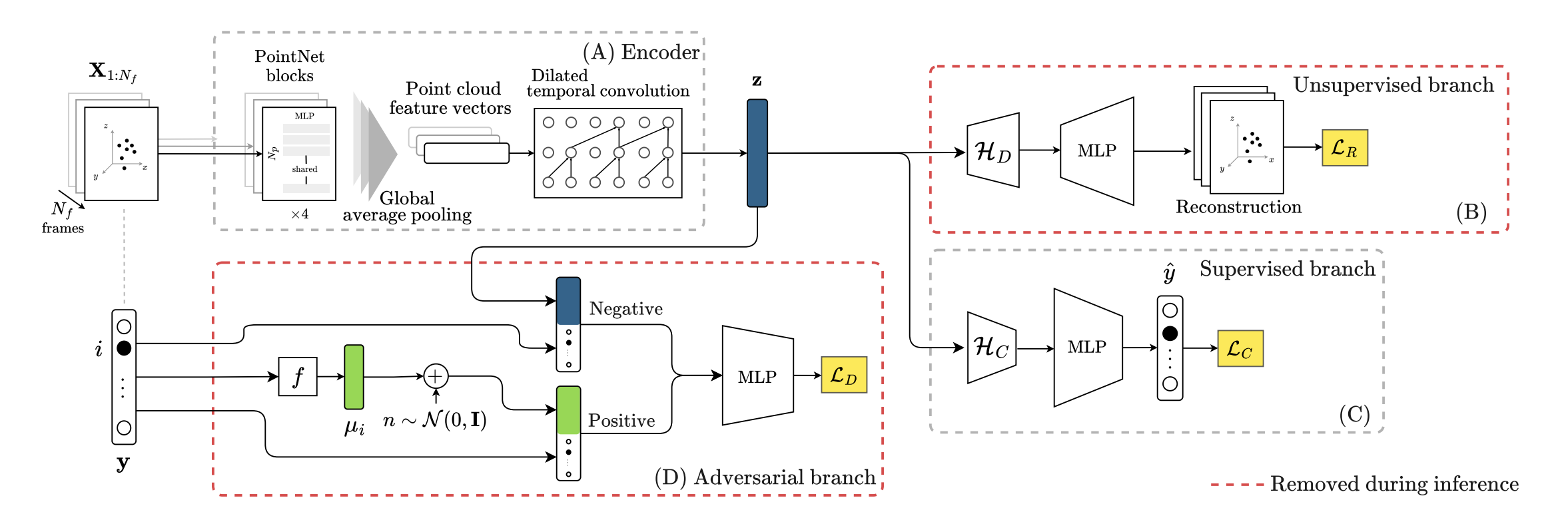
The model consists of a bunch of PointNet blocks and temporal dilated convolutions, I am not sure if it will run on a Cortex M4 CPU.
Experiments and Results
- Compared PCAA against OR-CED (previous µD-based open-set model adapted for point clouds), achieved ~24% average F1-score improvement over OR-CED.
- Tested across multiple openness levels (2.99–39.7%), the model performs robustly even when openness (unknown subjects ratio) is high.